Hair Regrowth Transplant
How Transplanted
Hair Grows
Scalp hair does not all grow at the same time. At any given moment hairs my be growing, resting, or shedding. They cycle on their own schedule.
Transplanted hairs cycle in this same random fashion.
The process of removing, dissecting, and transplanting donor hair generally “shocks” the follicles into the resting phase. For this reason, most
patients will shed all or most of the hairs in the grafts at about 6-8 weeks post-op. It has been observed that in some cases, post-op use of
Minoxidil may decrease this shedding.
Beginning 2-3 months post-op, the transplanted hairs begin to “germinate” below the skin. In-grown hairs may happen on occasion. They present as
a red, raised, pimple-like bumps in the grafted area.
In-grown hairs will resolve on their own time. Warm compresses can also be applied to the
affected area.
Transplanted hairs start to visibly regrow between months 4-6. At month 6, a patient may expect to see growth from 40-60% of the transplants.
Again, due to the random cycle of hair growth, not all grafts will start growing at the same time. Initially, the hair my be thinner and finer.
It will gain length and density as it matures.
Full growth from the transplants is usually achieved at 12 months. In some cases, this can take up to 18 months. This is especially common in
female patients. The transplanted hairs will continue to gain length over time.
Like good health and youth, most of us take a thick head of hair for granted -- that is, until it is gone. For many people, hair transplant
procedures can help bring back the appearance of a full -- or at least a fuller -- head of hair.
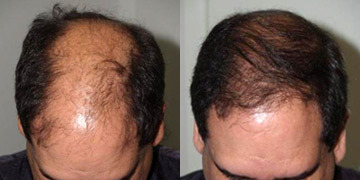
What Is a Hair Transplant?
Hair transplantation is surgery that involves removing a narrow strip of hair-bearing scalp from the back of the head and using it to fill an area with thin or no hair.
Most hair transplants are performed in the doctor's office under local anesthesia.
To transplant hair, the surgeon first cleans the scalp, then injects an anesthetic to numb the area where a 3- to 4-inch strip of scalp will be removed. After removing the strip of scalp with a scalpel, the surgeon sets it aside and sews the scalp closed. This area is immediately hidden by the hair around it.
Next, the surgeon divides the strip of removed scalp into approximately 500 to 2,000 tiny grafts containing an individual hair or just a few hairs each. The number and type of graft used depends on the hair type, quality, and color as well as the size of the area where it will be transplanted.
After the grafts are prepared, the surgeon cleans and numbs the area where the hair will be placed, creates holes or slits with a scalpel or needle, and delicately places each graft in one of the holes.
Depending on the extent of the procedure, the transplant will take approximately four to eight hours. Additional sessions may be needed if you continue to lose hair or decide you want thicker hair.
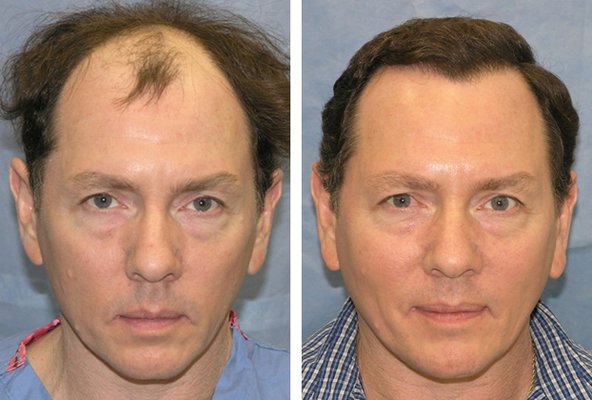
Expectations and Recovery
After hair transplant surgery, your scalp may be very tender. You may need to take pain medications for several days. Your surgeon will have you wear a surgical dressing over the scalp for at least a day or two. Your surgeon may also prescribe an antibiotic and/or anti-inflammatory drug to be taken for several days following surgery. Most people are able to return to work two to five days after surgery.
Within two to three weeks after surgery, the transplanted hair will fall out, but you should start to notice new growth within a few months.
Most people will have attained 60% of new hair growth after six to nine months. Some surgeons prescribe the hair-growing drug minoxidil (Rogaine) to improve hair growth following transplantation, but it is not known how effective this is.

|
 www.matrixclinic.in